I am interested to know what you make of the images. How does each portray the Pilgrims? Where Indigenous figures are present, how are they portrayed? How is the “New World” landscape depicted? How do the images present the Pilgrims’ claim to the land as God-given? How do the images idealize the Pilgrims’ resilience, piety, and conscientiousness?
Feel free to answer one or more of my questions, but you are also welcome to discuss the image on entirely different terms.
To jog your memory, I am including a gallery of thumbnail images below. For larger images, click on the thumbnails or consult the Story Map. In your response, please indicate the artist (where applicable), title, and date of the image on which you are commenting.
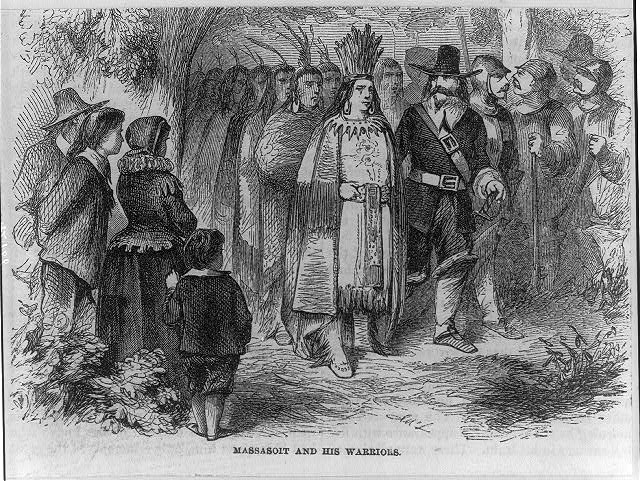
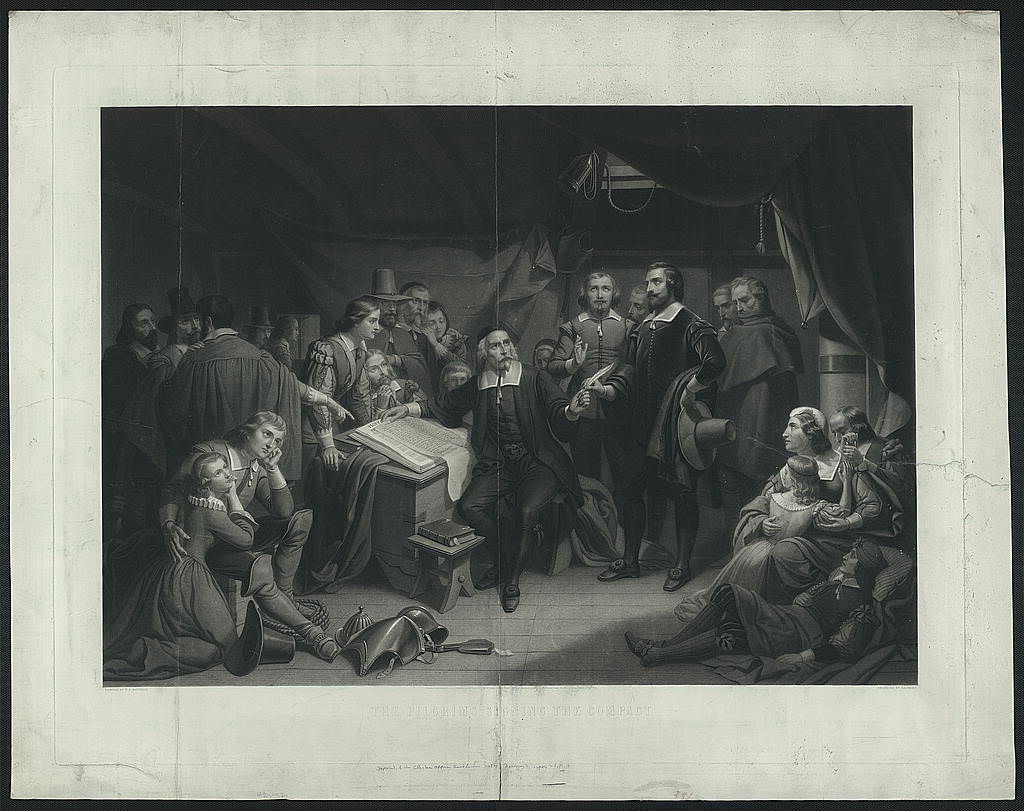
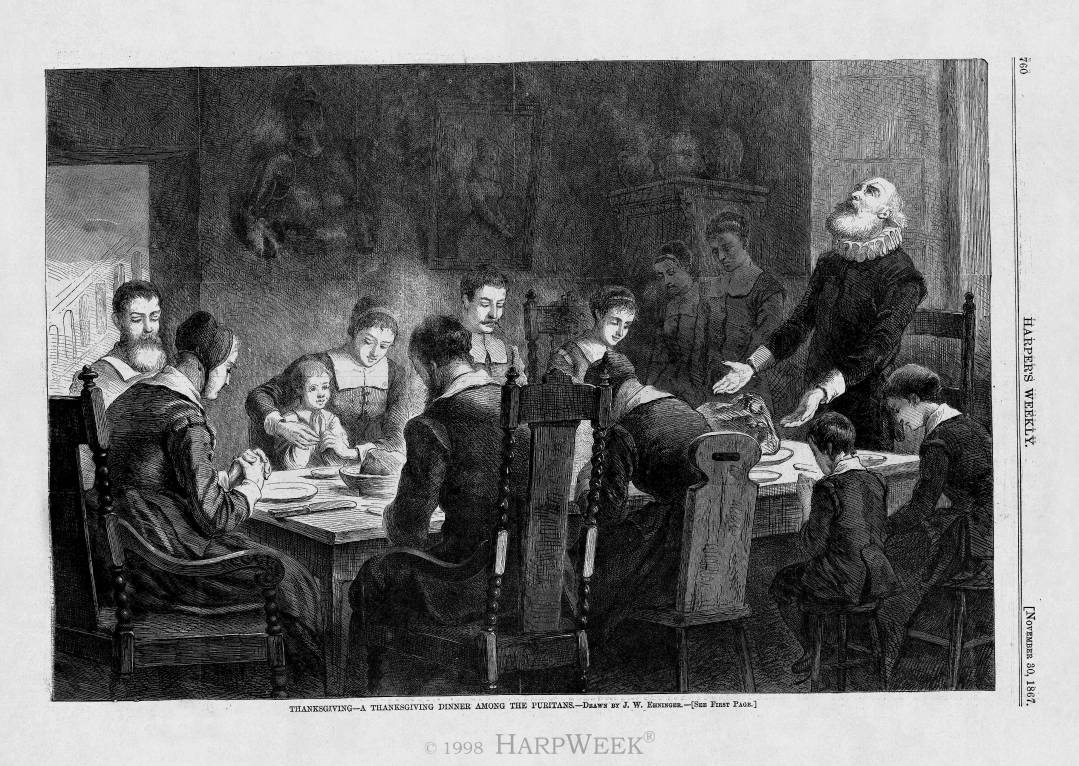
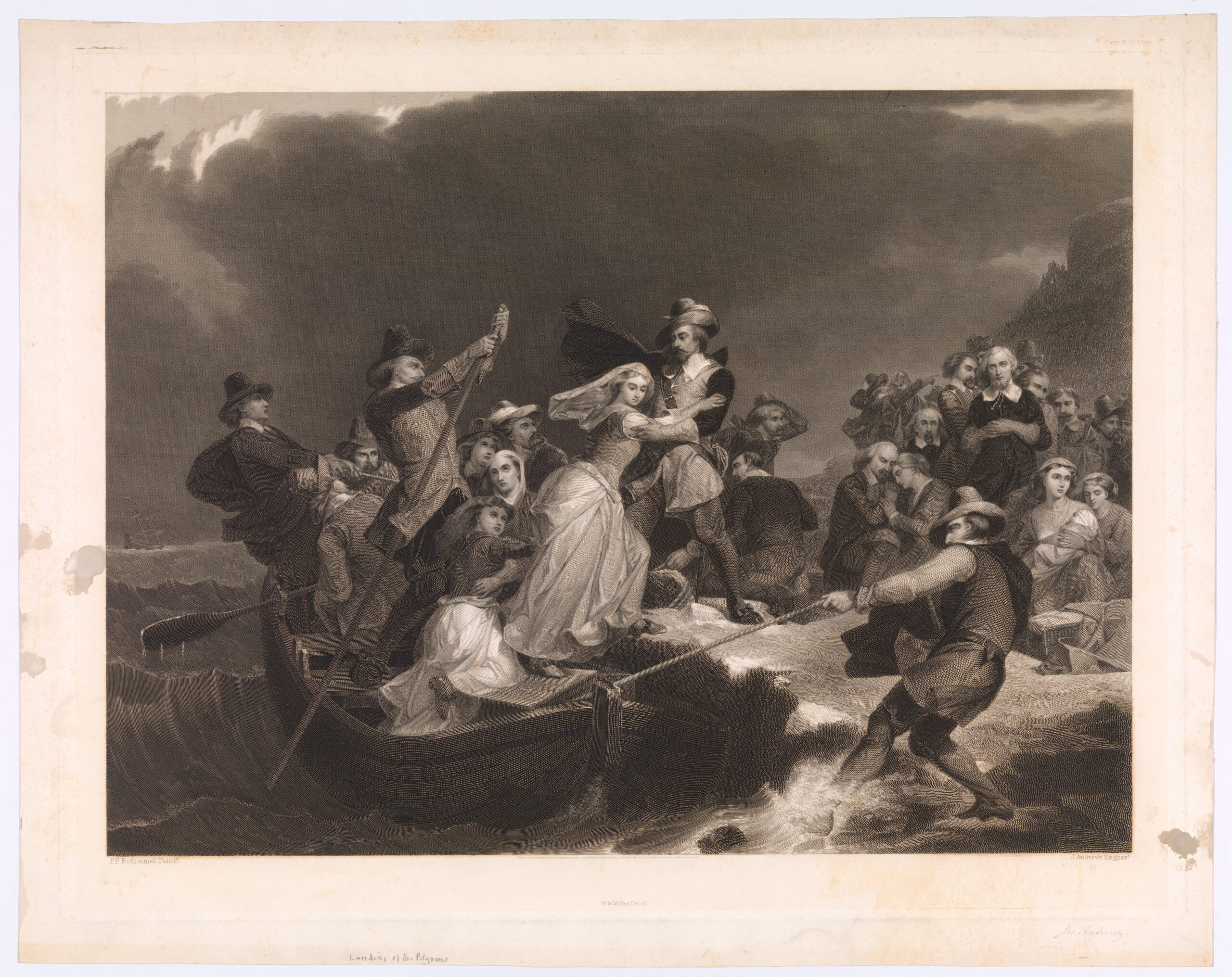
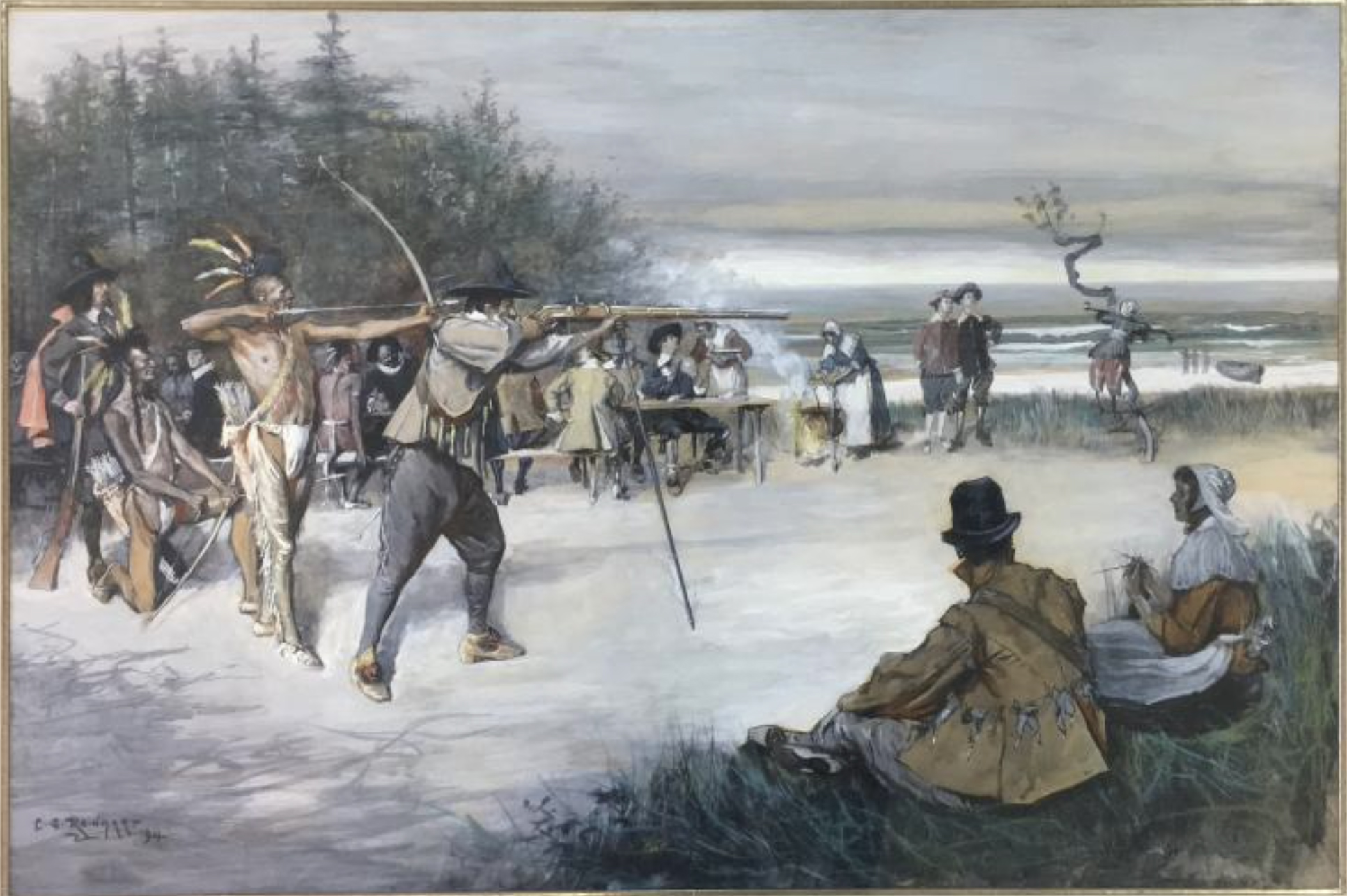
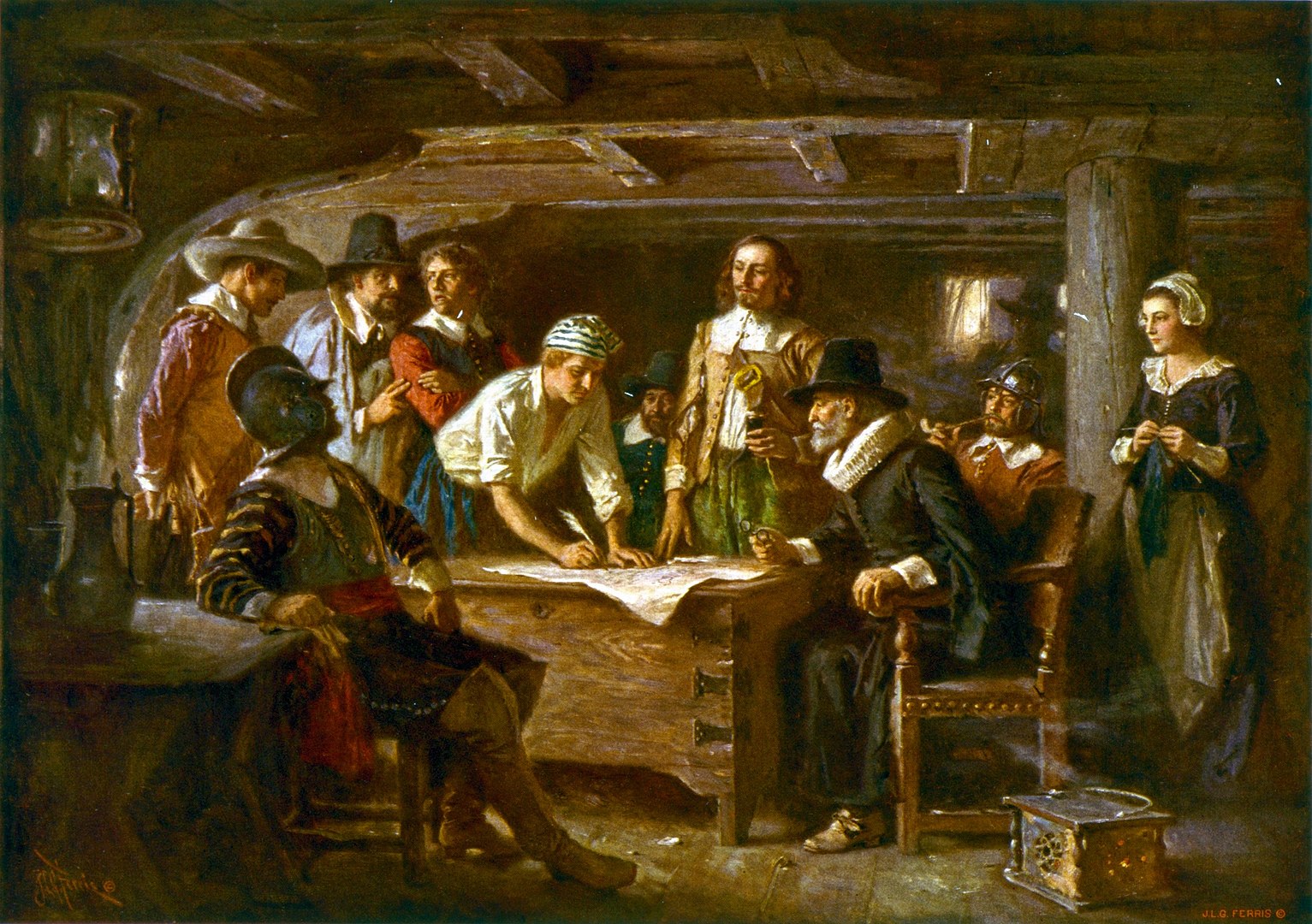
Enrico Causici, Landing of the Pilgrims, 1620. Relief Sculpture, Sandstone, 1825. Above the East Door of the U.S. Capitol Rotunda.Robert Walter Weir, Embarkation of the Pilgrims, 1857. Oil on canvas, 48 1/8 × 72 1/4 in. Brooklyn Museum.Emma Willard, Abridged history of the United States, or, Republic of America. New York: A.S. Barnes & Co., 1846, p. 51.Emma Willard, History of the United States, Or, Republic of America: With a Chronological Table and a Series of Progressive Maps. New York: A.S. Barnes & Company, 1852.Massasoit and His Warriors. Woodcut, 1857.The pilgrims signing the compact, on board the May Flower, Nov. 11th, 1620. Painted by T.H. Matteson; engraved by Gauthier, 1859.A Thanksgiving Dinner among the Puritans, by J. W. Ehninger. Illustration in Harper’s Weekly, Nov. 30, 1867.Joseph Andrews, Landing of the Pilgrims on Plymouth Rock, Engraving ca. 1869. After painting by Peter Frederick Rothermel.The Landing of the Pilgrims at Plymouth, Mass. Dec. 22nd 1620. Lithograph by Currier & Ives, 1876.Constantino Brumidi, “Landing of the Pilgrims, detail of the Frieze of American History,” U.S. Capitol Rotunda, 1877.Charles Stanley Reinhart, The First Thanksgiving, 1894.Jean Leon Gerome Ferris, The Mayflower Compact, 1620. Halftone photomechanical print, 1899.Jennie Augusta Brownscombe, The First Thanksgiving at Plymouth (1914), Pilgrim Hall Museum, Plymouth, MassachusettsJean Leon Gerome Ferris, The First Thanksgiving 1621 (1919). Reproduction of oil painting from series: The Pageant of a Nation. Copyright by The Foundation Press, Inc., Cleveland, Ohio. Jennie Augusta Brownscombe, Thanksgiving at Plymouth (1925), National Museum of Women in the Arts, Washington, D.C.
For my analysis I will comment on Thanksgiving at Plymouth (1925), by Jennie Augusta Brownscombe. Interestingly, Brownscombe was a descendant of a Mayflower passenger, so that may have influenced her portrayals in the painting. Brownscombe definitely portrays the pilgrims as strongly religious, as is evident by the man leading the prayer at the center of the table, along with the other pilgrims depicted praying. This painting also seems to be emphasizing the morality and simplicity that is often associated with pilgrims. The landscape of the painting implies that the pilgrims have conquered some new an unknown frontier, and made it their home. I feel like this is evident because the setting of the painting is near the water, with a ship in the background, suggesting a new arrival, while the small cabin and table setup suggest that the pilgrims have been able to survive and make a new life on this new land. The painting definitely contributes to the idea that the pilgrims claim to the land is god given. I think this is evident because of the prayer taking place at the table, but also because the Native Americans are kind of off to the side of the painting, even though they were the original inhabitants of the land. This arrangement could imply that the pilgrims have some sort of god given claim to the land, because they are the central figures of the painting as opposed to the Native Americans. This idea could be one of the contributing factors to the sentiments of inevitability surrounding the pilgrims arrival, because it implies that god ordained or facilitated their arrival in some way.
In “The First Settlement of New England” Webster states, “let us not forget the religious character of our origin. Our fathers were brought hither by their high veneration for the christian religion. They journeyed by its light, and labored in its hope.” This idea of christianity facilitating the founding of the U.S. (also implied in the painting), and also Christian ideals being made into a sort of cornerstone of the pilgrims ideals results in certain contemporary groups feeling a strong connection between Christianity and the founding of the U.S . People who have genealogical connections to the pilgrims or other ‘founders’ seem to have a strong connection to these ideals, and often use them for justifying feelings of superiority in comparison to other groups, for example the Society of Mayflower Descendants. However these feelings of superiority are not really justifiable, because most people are descended from immigrants who came to the U.S. seeking a better life, like the pilgrims.
I will focus on Enrico Causici’s Landing of the Pilgrims, 1620 (1825). In this sculpture, we see the initial landing of the Pilgrims, hinted at with the year 1620, engraved on the boat, the same year that the pilgrims landed at Plymouth, Massachusetts. The Native Americans, or “Indians,” are represented by a single individual. He is on a knee as the boat touches land. One theory I have is that the pilgrim standing above the kneeling Indian establishes a hierarchy. Causici places all the power in the pilgrims, who stand taller in the sculpture. The man stands upright, leading his wife and child, while the Indian is on a lower level. This emphasizes that although the pilgrims were intruding on Native American land, they felt that they deserved the respect of the land’s rightful inhabitants. That said, perhaps Causici could have positioned the kneel as a gesture of exchange and respect. The kneel seems voluntary, as evidenced by eye contact. Also, the kneeling Indian is offering the pilgrims corn. This gesture matters a lot. Corn was a staple of Indigenous cultures, so offering it to strangers shows immense generosity and respect. Now, rather than the narrative that the pilgrims “took” this land from the Native Americans, it seems that maybe the Native Americans happily welcomed the foreign pilgrims. As members of the native land, these communities possessed the knowledge and materials that the pilgrims needed to survive the first winter. Causici leads the viewer to believe that the pilgrims did not take from the Native Americans, but rather collaborated with them. Ultimately, the pilgrims are portrayed as superior, yet inexperienced visitors who relied on the help of the Native Americans.
While the sculpture depicts the pilgrims’ gratitude for the Native Americans and credits them with helping themselves survive the early years in America, this was not the reality. As Holly Allen’s story map explains, William Bradford describes the discovery of corn and beans as “a special providence of God, and a great mercy to these poor people…” when, actually, these crops were left behind by the Wampanoag. Bradford also describes Squanto, the pilgrims’ guide, as a “special instrument sent of God…” when Squanto was actually kidnapped and enslaved, and was in fact not sent from God. Lastly, although the 1621 harvest feast marked an alliance between the two groups, Bradford fails to recognize the destruction the pilgrims have caused. He crowns the pilgrims as rightful owners of the land, and fails to recognize the hazards they caused when they infiltrated and ultimately took over Native land. While touching, Causici’s sculpture does not accurately depict the reality of the Pilgrims’ arrival or their relationship with Native Americans. Lastly, this moment of exchange seems to suggest that the Pilgrims have earned the right to be there, with full agency, when they have not.
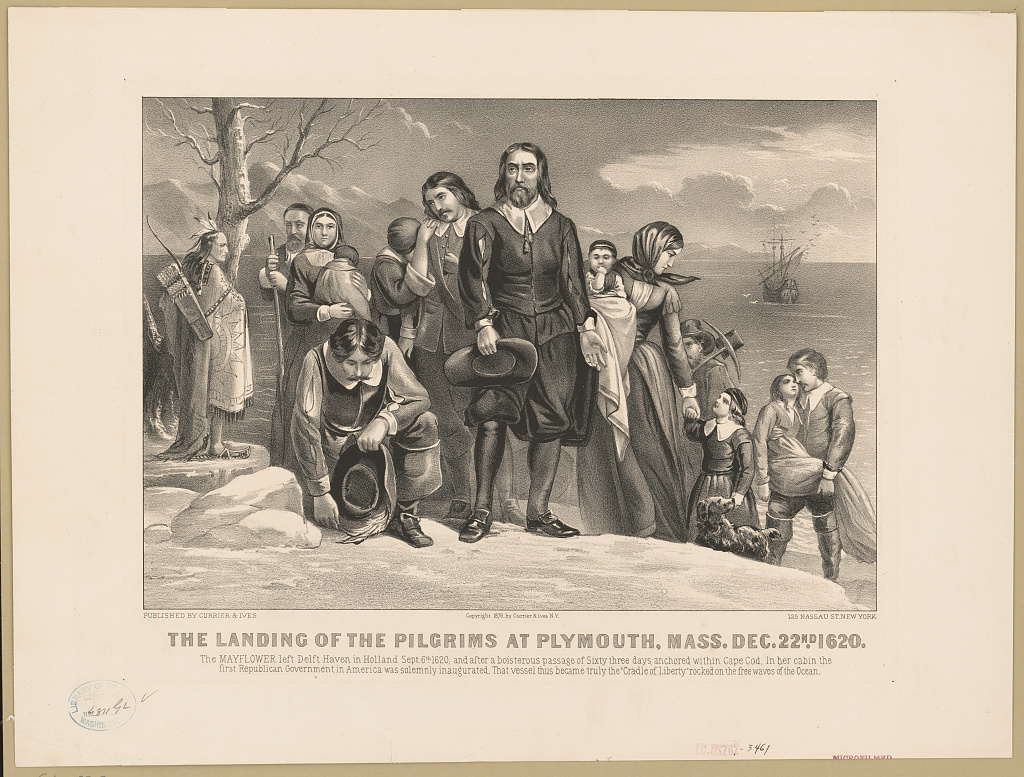
I am choosing to analyze the Currier and Ives The Landing of The Pilgrims at Plymouth, Mass. Dec 22nd 1620. (1876). Upon original analysis of this image, I am struck by the powerful portrayal of the Pilgrims and the fierce nature depicted upon their faces. I can understand the gravitation to a conquerors mindset in that these Pilgrims have just set foot into a world of endless possibilities filled with religious heroism. I also noticed the Mayflower in the background with the birds flying around it and the light parting the clouds in a “gift from God” implication. Finally, I noticed a Native American standing In the far corner facing out at the Mayflower as all of the Pilgrims are looking past the field of view.
This depiction of the Pilgrims touching ground clearly signifies the American Anglo-Protestant viewpoint and values. The Native American being shown only in the background as a smaller less meaningful figure aligns with the colonist centered focus of this piece, and reinforces the idea that the Natives were only bystanders to the European colonization of America. I also noticed how the Native American was almost unnoticeable in the backdrop, blending in with the tree next to them. I speculate this adds to the implication that the Natives were not really of any importance in this story. The Mayflower also appears similarly to the Frontier wagons as a symbol of freedom, hope, and purpose. I wonder if this is where the origins for the ideals of Manifest Destiny came to be.
The Pilgrims claims to the land as God-given can be seen through their behavior as the chosen few and the unity of their makeup, closely standing together with multiple generations together, breeding the idea of new hope and life. The use of light filtering through the sky to shine upon the Pilgrims can be noted as God’s blessing and a show of their righteousness. Beneath them, little is depicted in terms of ground or surroundings other than a barren tree. I think the man inspecting the neutral ground shows how the land was “waiting” for claim, void of all of the Native interactions and disturbance although in reality it had been cultivated for a long time prior to the Pilgrims arrival.
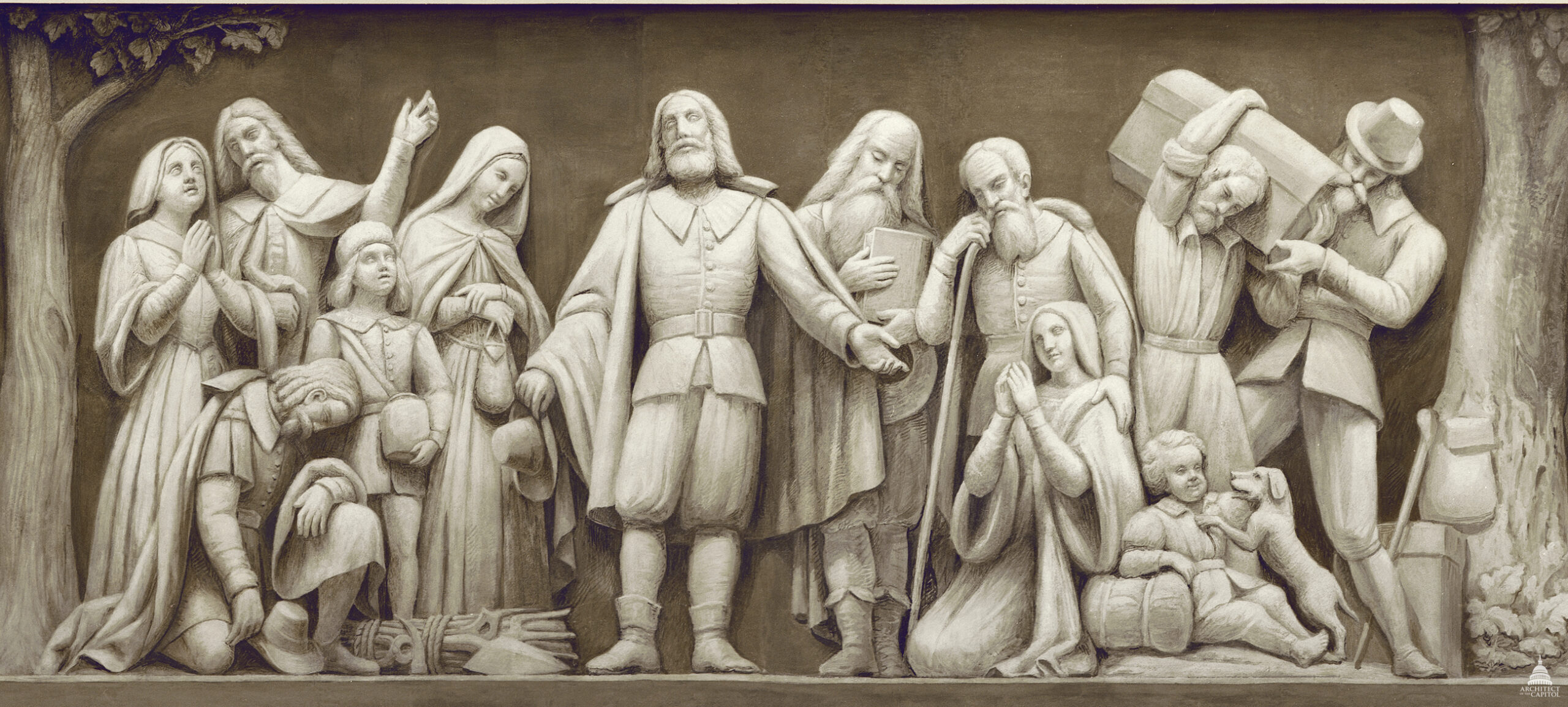
Constantino Brumidi’s 1877 “Landing of the Pilgrims” encapsulates the dominant Pilgrim origin story, centering religious piety and divine guidance. This piece depicts a group of Pilgrims giving thanks for their safe arrival in Plymouth, Massachusetts (Architect of the Capital). This piece is a true fresco, a technically demanding method in which pigments are applied directly onto wet plaster, binding the color permanently to the wall. True fresco, an exacting and labor-intensive technique, mirrors the perseverance and discipline attributed to the Pilgrims themselves. Together, the subject and medium elevate the Pilgrims’ arrival into a permanent, sanctified moment in the nation’s foundational myth.
The Pilgrims are portrayed as godly and hardworking. The central male figure stands upright, composed, and slightly elevated in posture. His stance evokes biblical iconography, recalling figures such as Moses or Christ; his outstretched arms suggest spiritual authority, guidance, and divine sanction. Multiple women in the piece appear to be praying, indicating that the Pilgrims are guided by their religion, a “faith [producing] the internal desire for a moral people to establish a society built on righteousness (The Pilgrim Myth).” Both women are dressed modestly, with one’s stance closely mirroring classical depictions of the Virgin Mary, another encapsulation of the Pilgrims’ devout Christian identity. A kneeling male figure demonstrates humility before God, reinforcing their piety. Another man carries a large trunk on his back, emphasizing physical labor and sacrifice, as if the Pilgrims are building their society from the ground up. A separate figure holds a book, likely a Bible, symbolizing the centrality of scripture in shaping their communal life. Lastly, a young boy sits beside a dog, an image of innocence that portrays the Pilgrims as gentle and family-oriented, rather than invasive settlers. Together, these details construct the Pilgrims as devout and disciplined, suggesting that their moral character serves as a justification for their claim to the land.
The absence of Indigenous figures is critical. Their absence reinforces the myth of an empty wilderness, erasing the longstanding presence of Indigenous peoples. Many narratives depict the land as a “promised land” and the “landscape as a gift from God, meant to be cultivated and settled by His chosen people (The Promised Land).” By visually excluding Native peoples, the image reinforces how the land was not considered an inhabited territory; it was instead a sacred opportunity for the Pilgrims to claim. Within this ideological framing, the “New World” landscape appears quiet and open. This portrayal, in turn, legitimizes the Pilgrims’ settlement as divine destiny rather than colonization.
When I first viewed this piece, it reminded me of Leonardo Da Vinci’s “The Last Supper.” Both works feature a central male figure surrounded by others engaged in varied gestures and expressions. This compositional parallel elevates the Pilgrim leader to Christ-like status, framing this moment as sacred. A central theme of “The Last Supper” is Christ’s impending sacrifice for humanity. Similarly, in traditional narratives of the Pilgrims, they are often described as sacrificing their home, safety, and comfort in pursuit of religious freedom. I wonder if Brumidi intentionally mirrored “The Last Supper,” positioning the Pilgrims’ arrival as divinely ordained, or if these compositional similarities are merely coincidental.
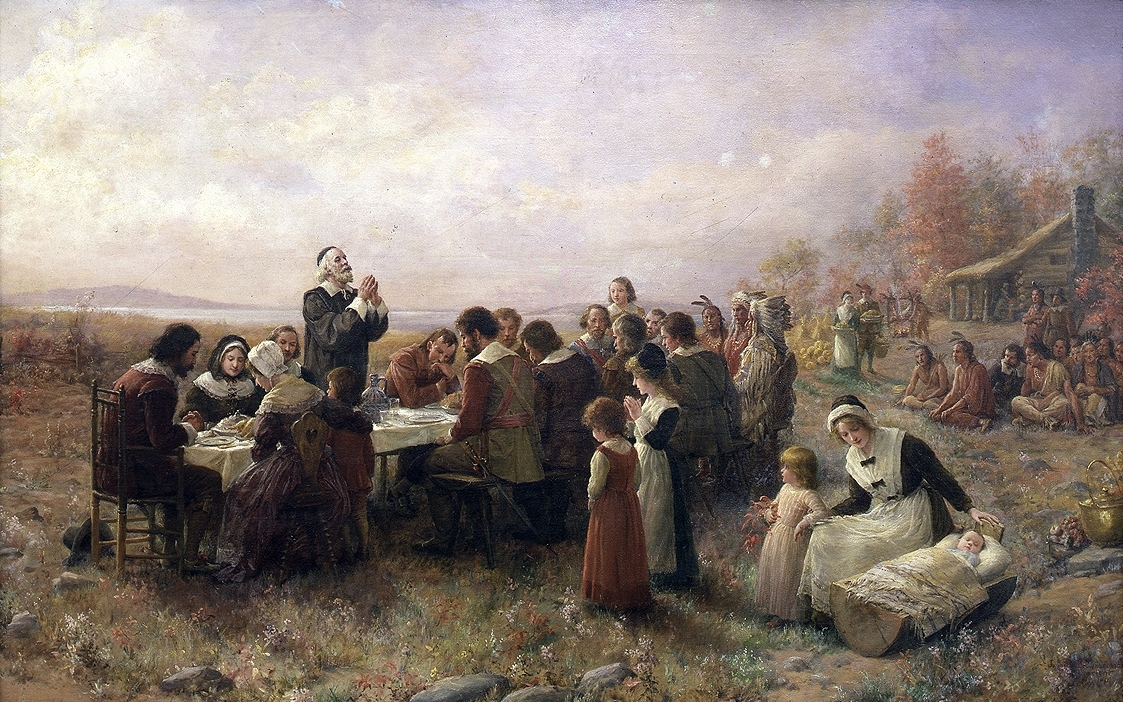


For my analysis I will comment on Thanksgiving at Plymouth (1925), by Jennie Augusta Brownscombe. Interestingly, Brownscombe was a descendant of a Mayflower passenger, so that may have influenced her portrayals in the painting. Brownscombe definitely portrays the pilgrims as strongly religious, as is evident by the man leading the prayer at the center of the table, along with the other pilgrims depicted praying. This painting also seems to be emphasizing the morality and simplicity that is often associated with pilgrims. The landscape of the painting implies that the pilgrims have conquered some new an unknown frontier, and made it their home. I feel like this is evident because the setting of the painting is near the water, with a ship in the background, suggesting a new arrival, while the small cabin and table setup suggest that the pilgrims have been able to survive and make a new life on this new land. The painting definitely contributes to the idea that the pilgrims claim to the land is god given. I think this is evident because of the prayer taking place at the table, but also because the Native Americans are kind of off to the side of the painting, even though they were the original inhabitants of the land. This arrangement could imply that the pilgrims have some sort of god given claim to the land, because they are the central figures of the painting as opposed to the Native Americans. This idea could be one of the contributing factors to the sentiments of inevitability surrounding the pilgrims arrival, because it implies that god ordained or facilitated their arrival in some way.
In “The First Settlement of New England” Webster states, “let us not forget the religious character of our origin. Our fathers were brought hither by their high veneration for the christian religion. They journeyed by its light, and labored in its hope.” This idea of christianity facilitating the founding of the U.S. (also implied in the painting), and also Christian ideals being made into a sort of cornerstone of the pilgrims ideals results in certain contemporary groups feeling a strong connection between Christianity and the founding of the U.S . People who have genealogical connections to the pilgrims or other ‘founders’ seem to have a strong connection to these ideals, and often use them for justifying feelings of superiority in comparison to other groups, for example the Society of Mayflower Descendants. However these feelings of superiority are not really justifiable, because most people are descended from immigrants who came to the U.S. seeking a better life, like the pilgrims.
I will focus on Enrico Causici’s Landing of the Pilgrims, 1620 (1825). In this sculpture, we see the initial landing of the Pilgrims, hinted at with the year 1620, engraved on the boat, the same year that the pilgrims landed at Plymouth, Massachusetts. The Native Americans, or “Indians,” are represented by a single individual. He is on a knee as the boat touches land. One theory I have is that the pilgrim standing above the kneeling Indian establishes a hierarchy. Causici places all the power in the pilgrims, who stand taller in the sculpture. The man stands upright, leading his wife and child, while the Indian is on a lower level. This emphasizes that although the pilgrims were intruding on Native American land, they felt that they deserved the respect of the land’s rightful inhabitants. That said, perhaps Causici could have positioned the kneel as a gesture of exchange and respect. The kneel seems voluntary, as evidenced by eye contact. Also, the kneeling Indian is offering the pilgrims corn. This gesture matters a lot. Corn was a staple of Indigenous cultures, so offering it to strangers shows immense generosity and respect. Now, rather than the narrative that the pilgrims “took” this land from the Native Americans, it seems that maybe the Native Americans happily welcomed the foreign pilgrims. As members of the native land, these communities possessed the knowledge and materials that the pilgrims needed to survive the first winter. Causici leads the viewer to believe that the pilgrims did not take from the Native Americans, but rather collaborated with them. Ultimately, the pilgrims are portrayed as superior, yet inexperienced visitors who relied on the help of the Native Americans.
While the sculpture depicts the pilgrims’ gratitude for the Native Americans and credits them with helping themselves survive the early years in America, this was not the reality. As Holly Allen’s story map explains, William Bradford describes the discovery of corn and beans as “a special providence of God, and a great mercy to these poor people…” when, actually, these crops were left behind by the Wampanoag. Bradford also describes Squanto, the pilgrims’ guide, as a “special instrument sent of God…” when Squanto was actually kidnapped and enslaved, and was in fact not sent from God. Lastly, although the 1621 harvest feast marked an alliance between the two groups, Bradford fails to recognize the destruction the pilgrims have caused. He crowns the pilgrims as rightful owners of the land, and fails to recognize the hazards they caused when they infiltrated and ultimately took over Native land. While touching, Causici’s sculpture does not accurately depict the reality of the Pilgrims’ arrival or their relationship with Native Americans. Lastly, this moment of exchange seems to suggest that the Pilgrims have earned the right to be there, with full agency, when they have not.
I am choosing to analyze the Currier and Ives The Landing of The Pilgrims at Plymouth, Mass. Dec 22nd 1620. (1876). Upon original analysis of this image, I am struck by the powerful portrayal of the Pilgrims and the fierce nature depicted upon their faces. I can understand the gravitation to a conquerors mindset in that these Pilgrims have just set foot into a world of endless possibilities filled with religious heroism. I also noticed the Mayflower in the background with the birds flying around it and the light parting the clouds in a “gift from God” implication. Finally, I noticed a Native American standing In the far corner facing out at the Mayflower as all of the Pilgrims are looking past the field of view.
This depiction of the Pilgrims touching ground clearly signifies the American Anglo-Protestant viewpoint and values. The Native American being shown only in the background as a smaller less meaningful figure aligns with the colonist centered focus of this piece, and reinforces the idea that the Natives were only bystanders to the European colonization of America. I also noticed how the Native American was almost unnoticeable in the backdrop, blending in with the tree next to them. I speculate this adds to the implication that the Natives were not really of any importance in this story. The Mayflower also appears similarly to the Frontier wagons as a symbol of freedom, hope, and purpose. I wonder if this is where the origins for the ideals of Manifest Destiny came to be.
The Pilgrims claims to the land as God-given can be seen through their behavior as the chosen few and the unity of their makeup, closely standing together with multiple generations together, breeding the idea of new hope and life. The use of light filtering through the sky to shine upon the Pilgrims can be noted as God’s blessing and a show of their righteousness. Beneath them, little is depicted in terms of ground or surroundings other than a barren tree. I think the man inspecting the neutral ground shows how the land was “waiting” for claim, void of all of the Native interactions and disturbance although in reality it had been cultivated for a long time prior to the Pilgrims arrival.
Constantino Brumidi’s 1877 “Landing of the Pilgrims” encapsulates the dominant Pilgrim origin story, centering religious piety and divine guidance. This piece depicts a group of Pilgrims giving thanks for their safe arrival in Plymouth, Massachusetts (Architect of the Capital). This piece is a true fresco, a technically demanding method in which pigments are applied directly onto wet plaster, binding the color permanently to the wall. True fresco, an exacting and labor-intensive technique, mirrors the perseverance and discipline attributed to the Pilgrims themselves. Together, the subject and medium elevate the Pilgrims’ arrival into a permanent, sanctified moment in the nation’s foundational myth.
The Pilgrims are portrayed as godly and hardworking. The central male figure stands upright, composed, and slightly elevated in posture. His stance evokes biblical iconography, recalling figures such as Moses or Christ; his outstretched arms suggest spiritual authority, guidance, and divine sanction. Multiple women in the piece appear to be praying, indicating that the Pilgrims are guided by their religion, a “faith [producing] the internal desire for a moral people to establish a society built on righteousness (The Pilgrim Myth).” Both women are dressed modestly, with one’s stance closely mirroring classical depictions of the Virgin Mary, another encapsulation of the Pilgrims’ devout Christian identity. A kneeling male figure demonstrates humility before God, reinforcing their piety. Another man carries a large trunk on his back, emphasizing physical labor and sacrifice, as if the Pilgrims are building their society from the ground up. A separate figure holds a book, likely a Bible, symbolizing the centrality of scripture in shaping their communal life. Lastly, a young boy sits beside a dog, an image of innocence that portrays the Pilgrims as gentle and family-oriented, rather than invasive settlers. Together, these details construct the Pilgrims as devout and disciplined, suggesting that their moral character serves as a justification for their claim to the land.
The absence of Indigenous figures is critical. Their absence reinforces the myth of an empty wilderness, erasing the longstanding presence of Indigenous peoples. Many narratives depict the land as a “promised land” and the “landscape as a gift from God, meant to be cultivated and settled by His chosen people (The Promised Land).” By visually excluding Native peoples, the image reinforces how the land was not considered an inhabited territory; it was instead a sacred opportunity for the Pilgrims to claim. Within this ideological framing, the “New World” landscape appears quiet and open. This portrayal, in turn, legitimizes the Pilgrims’ settlement as divine destiny rather than colonization.
When I first viewed this piece, it reminded me of Leonardo Da Vinci’s “The Last Supper.” Both works feature a central male figure surrounded by others engaged in varied gestures and expressions. This compositional parallel elevates the Pilgrim leader to Christ-like status, framing this moment as sacred. A central theme of “The Last Supper” is Christ’s impending sacrifice for humanity. Similarly, in traditional narratives of the Pilgrims, they are often described as sacrificing their home, safety, and comfort in pursuit of religious freedom. I wonder if Brumidi intentionally mirrored “The Last Supper,” positioning the Pilgrims’ arrival as divinely ordained, or if these compositional similarities are merely coincidental.