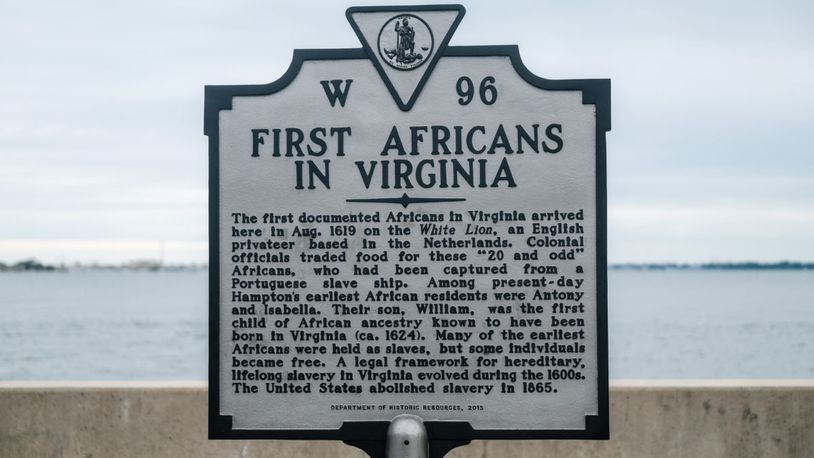
“This project is an origin story. It is not pretending to be the origin story. We are talking about a particular moment in time and making an argument and really asking a question: What would it mean to imagine 1619 as an origin story and how would that help us understand the country that we are?”
Nikole Hannah-Jones, Slavery and the American Revolution: A Historical Dialogue, March 6, 2020.
“My part has been to tell the story of the slave. The story of the master never wanted for narrators. The masters, to tell their story, had at call all the talent and genius that wealth and influence could command. They have had their full day in court. Literature, theology, philosophy, law and learning have come willingly to their service, and, if condemned, they have not been condemned unheard.”
Frederick Douglass, The Life and Times of Frederick Douglass, 1892, 581.
“The clash between the Times authors and their historian critics represents a fundamental disagreement over the trajectory of American society. Was America founded as a slavocracy, and are current racial inequities the natural outgrowth of that? Or was America conceived in liberty, a nation haltingly redeeming itself through its founding principles?”
Adam Serwer, “The Fight over the 1619 Project Is Not About the Facts,” The Atlantic, December 23, 2019.
The passages above raise issues that I hope we can discuss as we consider The 1619 Project: A New Origin Story. We will read important contributions to The 1619 Project and listen to corresponding podcast episodes. We will also consider the backlash that ensued when the New York Times published The 1619 Project in 2019. While The 1619 Project is a uniquely charged origin story, it raises questions that pertain to all stories of national origin, including: What is the purpose of history? Who gets to decide what and who is remembered from the past? What are the consequences of those decisions? How does that impact how one sees oneself as a citizen?
More specifically, The 1619 Project prompts us to consider how the United States can come to a place of truth and reconciliation about the history and legacy of slavery. What would such truth and reconciliation look like? Finally, how would considering 1619 as our country’s origin point help us better appreciate the contributions of Black Americans to U.S. culture and to democracy itself?
Week 6
Day 1 (3/16) – Selected Essays and Podcast Episodes from the 1619 Project
Nikole Hannah-Jones, “Origins” and “Democracy,” The 1619 Project, xvii-xxxiii, 7-38.
Interested students can listen to the podcast version of Hannah-Jones’ “Democracy” instead.
Dorothy Roberts, “Race,” The 1619 Project, 45-62.
Matthew Desmond, “Capitalism,” The 1619 Project, 165-186.
Interested students can listen to the podcast version of Desmond’s “Capitalism” instead.
Passages from The 1619 Project (Hannah-Jones, Roberts, and Desmond essays)
The 1776 Report and the Battle for Historical Memory (another Story Map)
Discussion Questions [1] [2] [3] [4] [5]
Day 2 (3/18): The 1619 Project, Florida, and History Wars
David W. Blight, “The Fog of History Wars.” The New Yorker, June 9, 2021.
Trymaine Lee, “Teaching the Truth,” Into America podcast (MSNBC), March 23, 2023.
Executive Order Ending Radical Indoctrination in K-12 Schooling, January 29, 2025.
U.S. History Wars and the Politics of Race (Story Map)
Other states, other controversies (recommended, not required):
Federal Framing:
AHA Condemns Report of Advisory 1776 Commission (January 2021)
