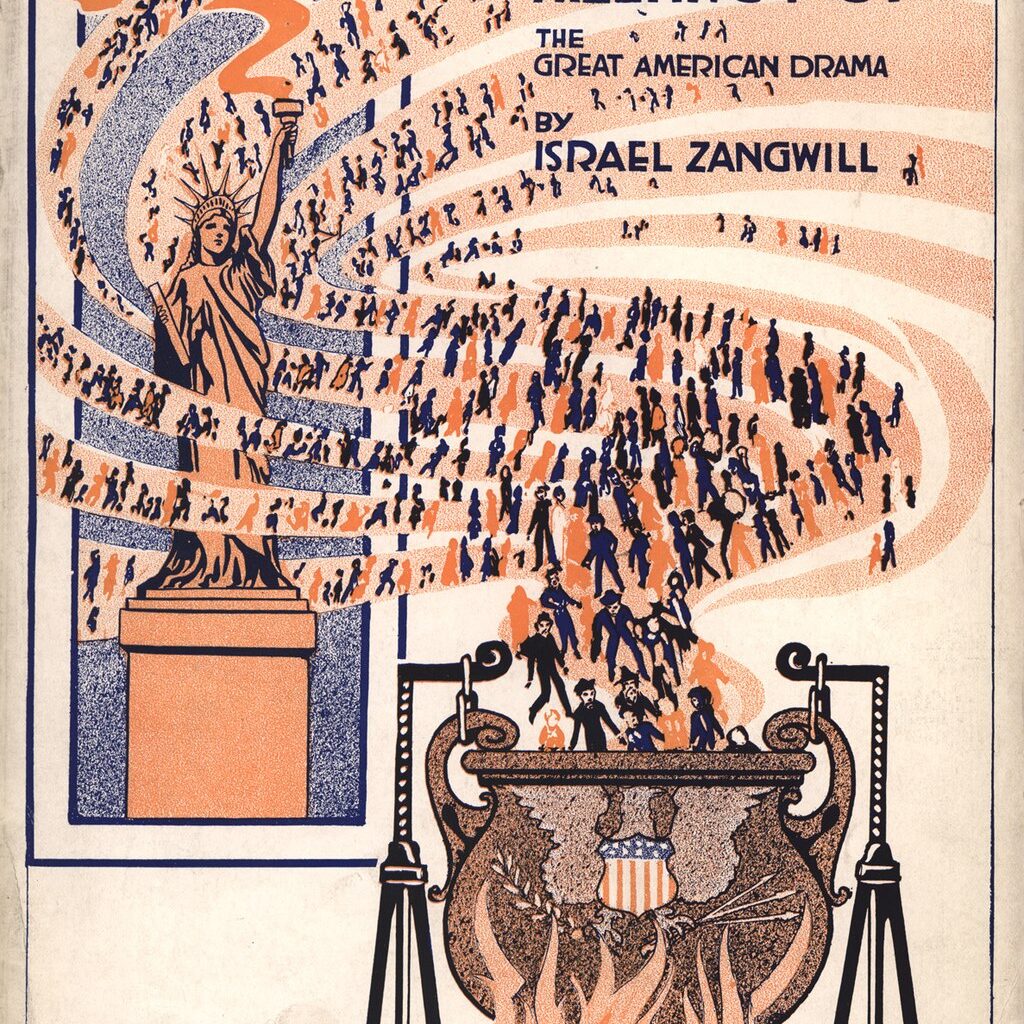
“. . . America is God’s Crucible, the great Melting Pot where all the races of Europe are melting and re-forming! Here you stand, good folk, think I, when I see them at Ellis Island, here you stand in your fifty groups, with your fifty languages and histories, and your fifty blood hatreds and rivalries. But you won’t be long like that, brothers, for these are the fires of God you’ve come to – these are the fires of God. A fig for your feuds and vendettas! Germans and Frenchmen, Irishmen and Englishmen, Jews and Russians – into the Crucible with you all! God is making the American.”
Israel Zangwill, The Melting Pot, 1908
“Of course, from the beginning, the melting pot has been seen as an ambiguous symbol of American unity; it has been looked upon as a myth providing cohesion and a sense of evolving Americanness on the one hand, and as an instrument of forced acculturation and violent assimilation on the other. Several questions suggest themselves when assessing this myth: Who is in the ‘pot’ and who is doing the ‘melting’? What exactly is melted down? Which elements would prove to be resilient or dominant in the process, and with what result?”
Heike Paul, The Myths that made america, 2014
Various groups have used the melting pot to bolster their claims to cultural and political authority, including immigration restrictionists, nativists, multiculturalists and pro-immigration advocates. As David Michael Smith writes, “This universality is what helps to make the melting pot a central theme of American identity.” (Smith, 400). In this section of the course, we will explore different versions of the melting pot myth as expressed in narrative, ritual, and iconography. Because the melting pot was an especially influential concept in the early 20th century, we will begin our study there. We will then consider the persistence of the melting pot narrative throughout recent U.S. history, always asking Heike Paul’s questions: “Who is in the ‘pot’ and who is doing the ‘melting’? What exactly is melted down?” And we will ask of every version of the melting pot story: Who is and who is not counted as a citizen?
Week 8
Day 1 (3/30): The Melting Pot Narrative and America’s “Golden Door”
Schoolhouse Rock, “The Great American Melting Pot,” 1977.
Emma Lazarus, “The New Colossus” (1883; installed at the base of the Statue of Liberty in 1903).
Mary Antin, “The Lie,” The Atlantic, August 1913.
Anzia Yezierska, “How I Found America,” Hungry Hearts (1920) If you prefer, you can read this pdf version.
“The Melting Pot Myth” (Story Map).
Recommended (not required): Woodrow Wilson, “Americanism and the Foreign-Born, May 10, 1915.
Discussion Question [1] [2] [3] [4] [5]
Day 2 (4/1): The Melting Pot and America’s “Guarded Gate”
Recommended (not required): Paul A. Kramer, “Not Who We Are.” Slate, February 3, 2017.
Theodore Roosevelt, “Children of the Crucible,” 1917.
David A. Reed, “America of the Melting Pot Comes to an End.” New York Times, April 27, 1924
“An Un-American Bill:” A Congressman Denounces Immigration Quotas, Speech by U.S. Representative Robert H. Clancy (Detroit), April 8, 1924
Statistical background:
Immigration Quotas, 1925-1927, History Matters
Repatriation and Deportation of Mexicans 1932-1936, Boulder County Latino History.
The American Melting Pot: Fears of Dilution and Cultural Decay (Story Map)
Discussion Question [1] [2] [3] [4] [5] [6]
Week 9
Day 1 (4/6): Telling Different Migration Stories
Oral history of Mary Tsukamoto in John Tateishi, And Justice for All (1984), 3-15.
Gloria Anzaldúa, Borderlands/La Frontera (1987), selections.
Safia Elhillo, “Searching for the Words to Describe Myself,” Harper’s Bazaar, July 6, 2021.
Roxanne Dunbar-Ortiz, “Stop Saying This Is a Nation of Immigrants!” MR Online,” May 29, 2006.
Discussion Questions [1] [2] [3] [4]
Day 2 (4/8): Migrants, Borders, and Nativism Today
Please peruse the following anti-immigrant websites/organizations:
Mass Deportation Coalition – Purpose. See also Mass Deportation Coalition Playbook, March 30, 2026.
“Illegal Immigration,” Federation for American Immigration Reform.
Center for Immigration Studies
Please also examine the following materials on the “Great Replacement” theory:
“‘The Great Replacement:’ An Explainer,” American Defamation League.
“Nothing About What’s Happening Is an Accident,.” Tucker Carlson Show. Fox News, September 22, 2021.
Finally, please read the following:
Trump and Noem Remarks at the Homeland Security Roundtable – October 23, 2025.
ICE recruitment post: “Which Way, American Man?”
“We’ll Have Our Home Again” (Mannerbund Song)
US Department of Labor, “One Homeland. One People. One Heritage” (Twitter post), Jan. 10, 2026.
Present-day Nativism and the “Nation of Immigrants” Myth (Story Map)
