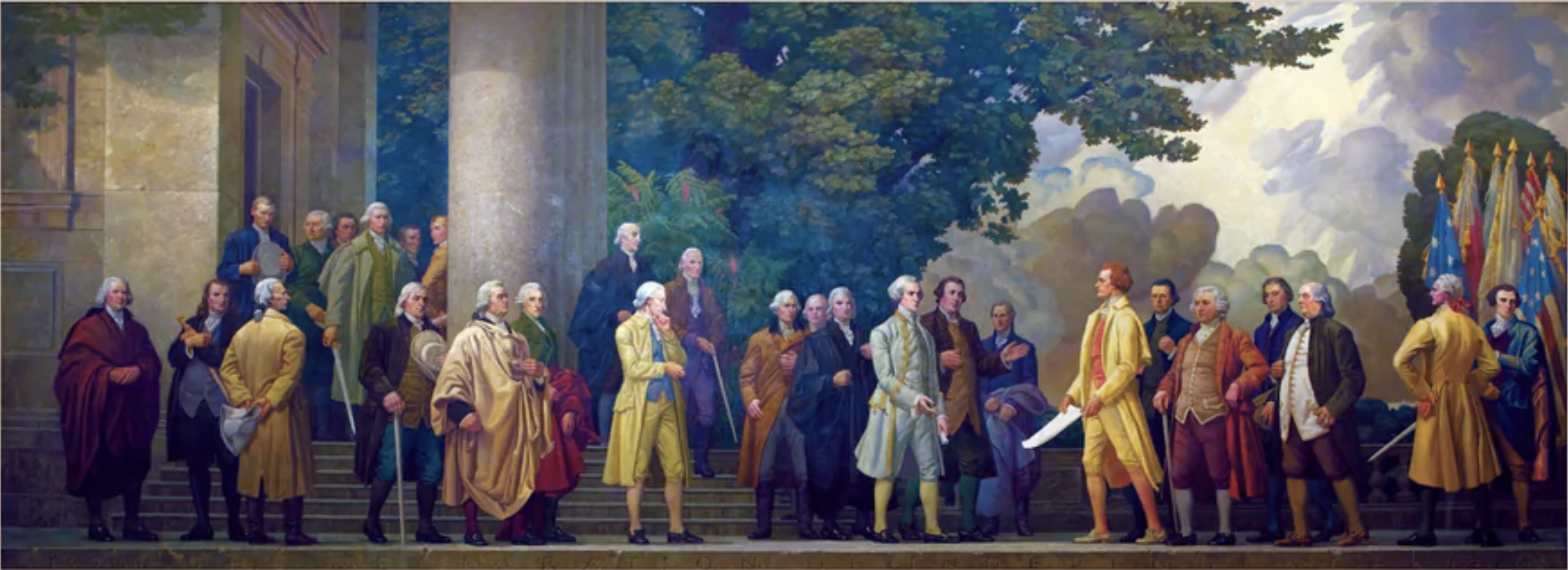
Is the United States a nation in decline from a golden past, a founding moment of perfection that we can only strive to emulate but are fated to miss the mark? Or did the flawed founders set a standard that they failed but that we are continuing to struggle to approach? How are we to balance the tension between our heritage of individual freedoms and our sense of common purpose toward each other and our country? What is the proper role of government, and what are its limits? What is the nature of belonging to our country—who belongs, and who doesn’t? How do we negotiate between the enduring wisdom of the founding fathers and their only-human inability to see fully their own time or the future?
These are the kinds of answers that we seek every time the American Revolution comes up, whether we’re watching a movie, reading a book, attending a march, pleading a case, or going to a historic site.
Andrew M. Schocket, Fighting over the Founders: How We Remember the American Revolution, 2015.
What the American Revolution gave the United States was an actual idea of a moment of origin, which many other countries in the world don’t have. And the consequence of that is that we’ve invested these particular years of these particular people with a set of stakes that are so far beyond what any set of events and any set of people can plausibly carry. And that has made our perception of it very unreal and detached from what actually went on.
Maya Jasanoff in “The American Revolution” documentary, 2025.
If one wants a national origin story that’s clean and neat and tells you very clearly who the good guys are and who the bad guys are, the American Revolution…is not that story.
Vincent brown in “The American Revolution” documentary, 2025.
As we explore narratives, rituals, and iconography of the American Revolution and Founding Fathers, we will address the following questions:
- What is the relationship between the Revolution and American exceptionalism?
- What is the place of the Revolution in U.S. national identity today?
- What role did slavery play in the American Revolution?
- What role did religion play in the lives of the Founders and in the founding documents? How has that role be reimagined over time?
- What are the conventions of popular narratives of the Revolution?
- How does the state, allied institutions, and cultural producers attempt to stabilize 1776 as a national origin?
Week 4
Day 1 (3/2) – The Founding Fathers
Schoolhouse Rock, “No More Kings” (1975), “Shot Heard ’Round the World” (1975), and “Fireworks” (1976), “The Preamble” (1975).
Henry Steele Commager, “A Generation of Heroes,” National Parks and Conservation Magazine, July 1976, 9–13. (Here are some significant passages)
Founding Documents in the Rotunda for the Charters of Freedom, National Archives Museum (Just browse the site and consider this passage.)
“The Founding Fathers and 1776: Commemoration, Myth, and National Identity” (Story Map)
Discussion Questions [1] [2] [3] [4] [5]
Day 2 (3/4) – The Revolution in Popular Film and Television
Roland Emmerich, The Patriot, 2000 (streaming video in Library collection).
Kevin Phillips, “‘Patriot’s’ Skirmish With Truth,” Los Angeles Times, July 7, 2000.
Recommended (because it will make you laugh!): Tom Reimann, “The Patriot Is the Perfect Dumb Movie to Celebrate the Fourth of July,” Collider, July 4, 2020.
Some of my thoughts on The Patriot.
In-class clips: Sons of Liberty (History Channel, 2015-16)
Discussion Questions [1] [2] [3] [4] [5]
Week 5
Day 1 (3/9) – Hamilton, Race, and Culture
Lin-Manuel Miranda, Hamilton: An American Musical (2015) – watch the Disney-Plus recording if you have access. Here is a less polished free streaming option; you can also watch these clips: [1] [2] [3] [4] [5] [6]
Recommended: Extra!, Ep. 3: The Hamilton Moment, The Junto podcast, Nov. 3, 2015.
My thoughts on Hamilton: The Musical
Here is a Story Map that is less focused on specific assigned readings.
Discussion Questions [1] [2] [3] [4] [5] [6]
Day 2 (3/11): Who Owns 1776? The Semiquincentennial and the Politics of Commemoration
Jill Lepore, “Revolutionary Whiplash,” The New Yorker, Nov. 17, 2025.
Prior to class, please watch “An Asylum for Mankind (May 1775 – July 1776).” The American Revolution, directed by Ken Burns, Sarah Botstein, and David Schmidt, PBS, 2025.
Working in groups during class, students will watch an episode of “America at 250: The Road to Liberty,” PragerU, 2025.
Discussion Questions [1] [2] [3] [4] [5]
