The story of the “First Thanksgiving” at Plymouth in 1621 was invented in the nineteenth-century. According to James Robertson, the holiday is “a ritual affirmation of what Americans believe was the Pilgrim experience, the particularly American experience of confronting, settling, adapting to, and civilizing the New World” (American Myth, American Reality, 1980, p. 15). As we know from reading William Bradford, the colonists believed that divine providence guided them to Plymouth; thus, they were divinely entitled to claim the land they found there. In Of Plymouth Plantation, Bradford describes the land as “fruitful and fit for habitation, though devoid of all civilized inhabitants and given over to savages, who range up and down, differing little from the wild beasts themselves.”
Just as Bradford describes the Indigenous inhabitants as “savages,” the traditional story of Thanksgiving distorts interactions between the colonists and the Wampanoag people, whose ancestors had lived on the land claimed by the Plymouth colonists for thousands of years. While the colonists and the Wampanoag forged an alliance that lasted for roughly fifty years, European settlement was devastating to Indigenous peoples. Since 1970, Wampanoag and other Indigenous activists have staged a National Day of Mourning coincident with the Thanksgiving holiday in Plymouth.
The Thanksgiving holiday ritually affirms the myth of Americans as a Chosen People, guided to the New World by divine providence. Carefully consider the following images, created between 1894 and 1925, which depict the events of the “First Thanksgiving” in 1621. In each of the images, how are the Pilgrims and Wampanoags depicted? How do the images reinforce the idea of the Pilgrims as a Chosen People? What else do you notice about the images?
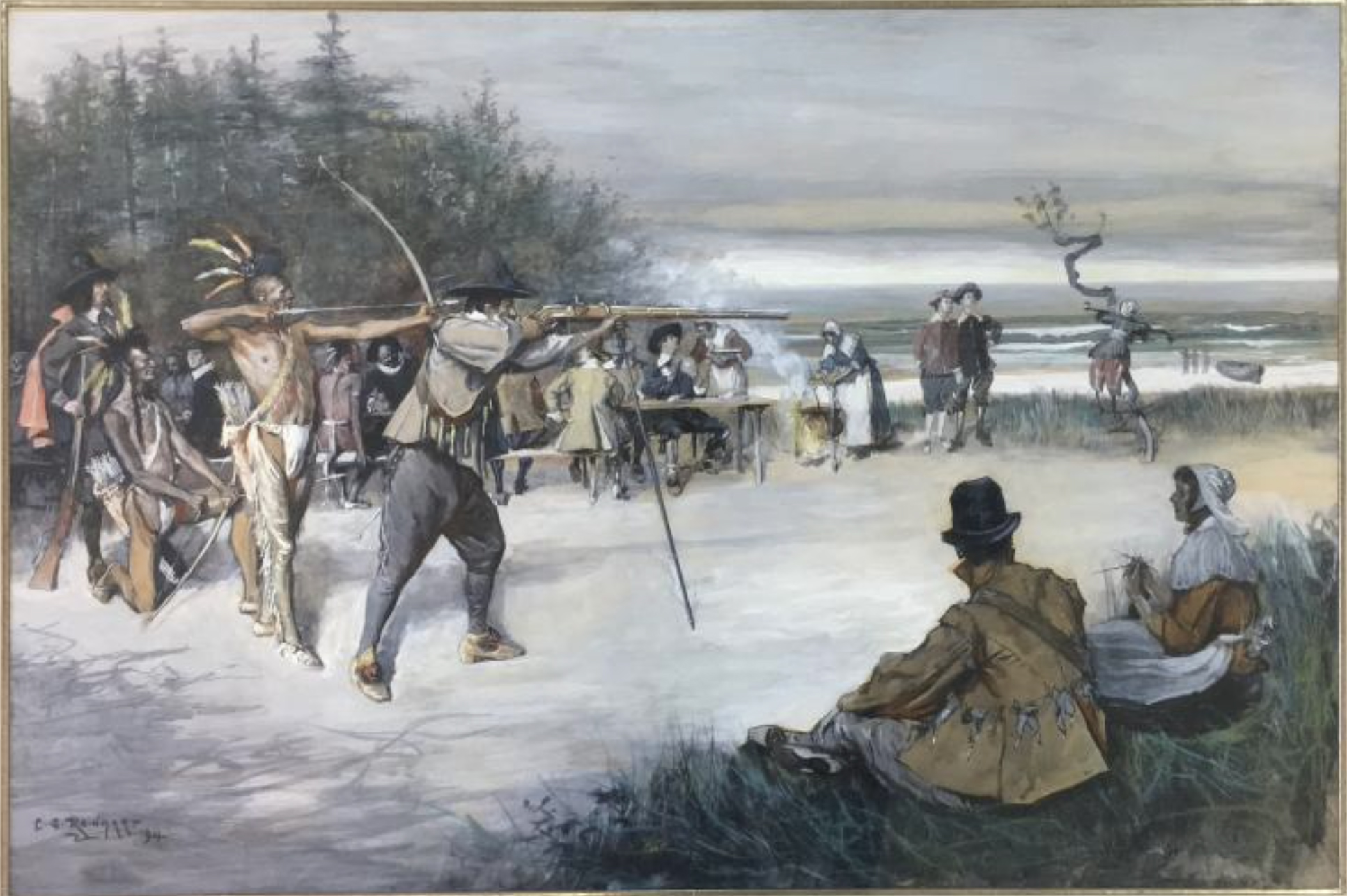

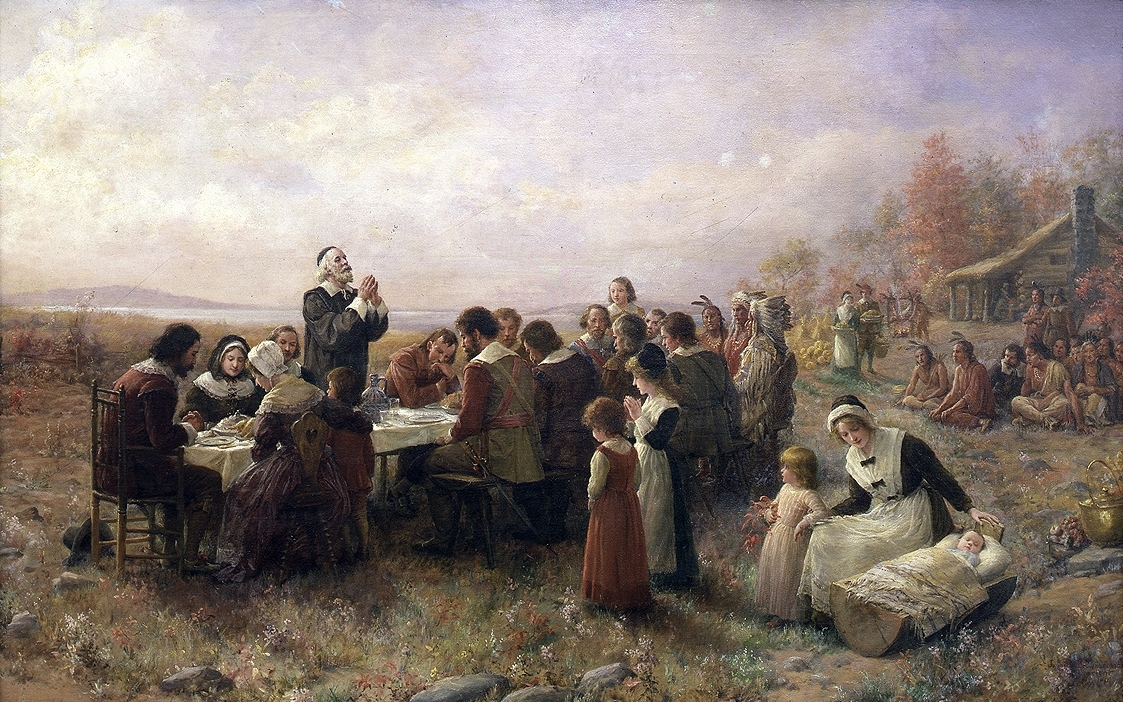


The “First Thanksgiving” in Commercial Media
Let’s also consider how the “First Thanksgiving” was portrayed in greeting cards, postcards, and print advertising from the late 1800s through the first decades of the 20th century. In the United States, holiday greeting cards started to become popular in the 1870s following the advent of chromolithography. Around the same time, advertising trade cards also became popular. At a time when colorful, mass-produced images were still fairly novel, Americans regarded trade cards not simply as advertisements but as collectibles, which they arranged in trade card albums. Likewise, colorful postcards became popular collectible items in the United States following the World’s Columbian Exposition in 1893. A postcard-collecting craze began in the 1890s and lasted until the start of World War I.
So, we are considering three visual forms that were popular from the 1870s to the 1910s: holiday greeting cards, advertising trade cards, and postcards (three additional print ads are also included). As we consider how these forms depicted the “First Thanksgiving,” let’s also think about the broader historical context in which they appeared. The period from 1880 to 1920 was a period of rapid industrialization for the nation. As U.S. factories grew, immigrants arrived in huge numbers, primarily from Southern and Eastern Europe, to work in them. The new immigrants forged an ethnic working class that was linguistically, culturally, and religiously diverse; in this wave of immigrants, Catholics and Jews outnumbered Protestants. As we will explore more when we consider the “Melting Pot” myth, the arrival of so many non-Anglo-Saxon-Protestant migrants engendered a nativist backlash. Images of the Pilgrims and the “First Thanksgiving” took on new meaning in the midst of mass immigration and the nativist response to it. The Pilgrims were not only constructed as the first Europeans to settle in North America (which they were not!), but they were also celebrated as the founders of a white, Anglo-Saxon Protestant society. Keep that in mind as you consider the images below. Also note the depiction of Indigenous people in some of the images. (Click on each image to see enlargement.)


Leave a Reply
You must be logged in to post a comment.